I’m one of the core developers of Veloren. Sadly, I don’t get much time to work on the project nowadays: if you’re a parent too you’ll understand, I’m sure.
In this post I want to document some of the unusual choices that have been made during Veloren’s development. If you’re working on a game you might find some of them interesting.
ECS
Veloren is built on an ECS (Entity Component System) rather than a more traditional object-oriented class hierarchy. Nowadays - and especially in the Rust ecosystem - this is much more common, but when we started the project in 2018 it was surprisingly rarely used for anything but demoware and we had to invent a lot of concepts internally to make it work for our needs.
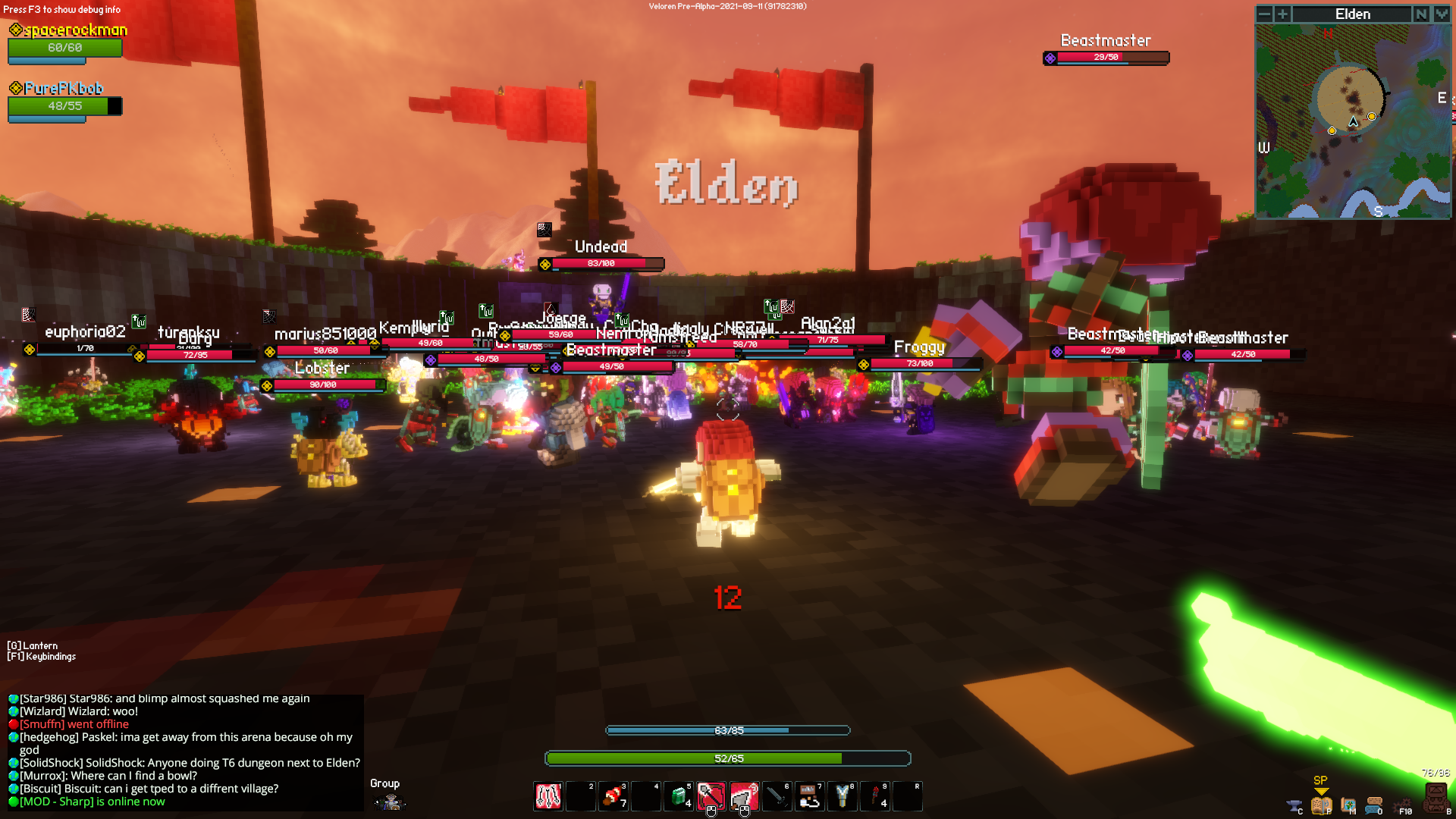
We’ve benefitted massively from this decision: Veloren scales far better than most multiplayer games and will happily hit 50% core utilisation on a 48 thread server with over 500 players connected and 10s of thousands of entities interacting in the game world. Most MMOs can only achieve these numbers by either reducing the scope of gameplay (fewer cross-entity interactions) or aggressively sharding players across different world spaces.
ECS does have some unexpected quirks. In a traditional game engine, different kinds of entities are separated by a compile-time bifurcation at the type level, with polymorphism between classes being an opt-in for specific cases. With an ECS, polymorphism is the default and a taxonomy of entities is something that must be opted into. This has resulted in some interesting side effects:
-
We once had a bug in which players were assigned an
ItemDropcomponent based on the items they were carrying. Due to a slightly botched transition between the way loot was implemented, this resulted in players being able to ‘pick up’ other players when nearby. This would drop the player’s entity, kicking them from the game server. -
When we first implemented mounts (the ability for characters to ride things like horses), the cycle detection logic (that prevents mutually-mounted entities) and the control passthrough logic (which allows the rider to pass control instructions to the mount) were both faulty. This meant that players could construct enormous towers of entities all riding the one below, or even create mount cycles, which resulted in amusing Bethesda-style catherine wheels of chaos as the physics engine tried desperately to resolve the contradictory mounting constraints.
Player / NPC duality
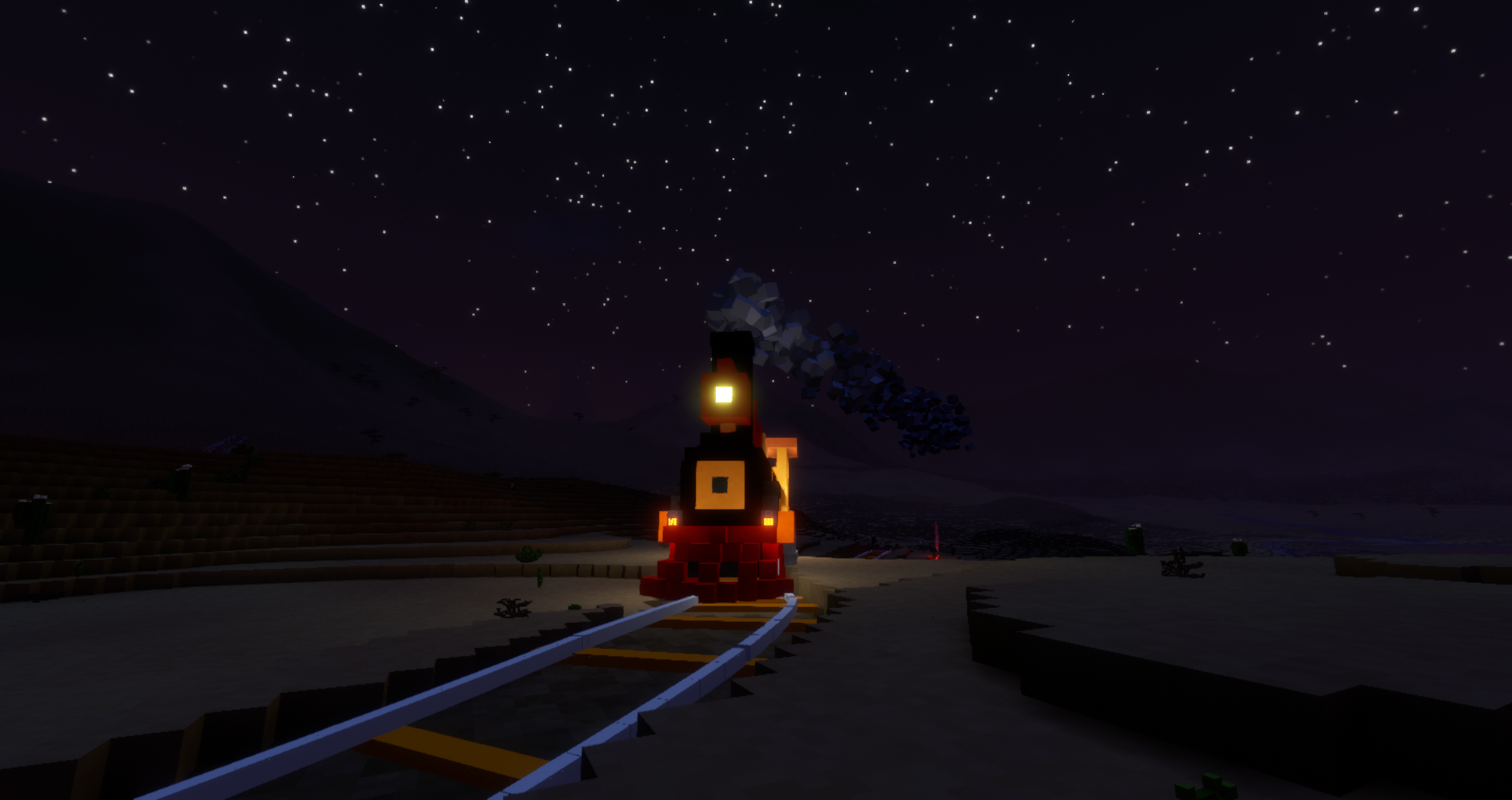
To the maximum possible extent, player characters and NPCs are the same. For example, both:
-
Interact with the physics engine in the same way. NPCs cannot teleport, phase through blocks, or artificially control their physics properties. If the NPC’s agent code isn’t smart enough to account for the NPC’s momentum and friction when traversing a cliff edge, they will fall off.
-
Have exactly the same movement control options. All movement and control options go through the
ControllerECS component, which acts as a sort of virtual gamepad. For players,Controllerinputs are provided by the player’s keyboard, mouse, and physical gamepad inputs. For NPCs,Controllerinputs are provided by the game’sagentdecision tree system. -
Are governed by the same movement controller code.
Controllerinputs are constrained by the physical abilities of the character’s body and translated into inputs for the physics engine with exactly the same code. -
Have the exact same skill tree and experience system. In previously iterations of the game sound effects would even get played when a nearby NPC levelled up!
Chonks
Veloren is a voxel game. Usually, voxel games take one of several approaches to storing their terrain data:
-
Big 3D arrays of blocks, addressed via some sort of hash table into a series of chunks
-
RLE-encoded voxel data, usually grouped into chunks
-
Octrees, where the whole world is defined as a recursive tree of increasingly smaller voxel 2x2x2 cubes
In practice, each approach has big problems. Big arrays are fast but provide little scope for compression. RLE only compresses well when the voxel data appears as large groups of homogenous blocks, and has awful random access performance. Octrees are extremely unfriendly to modern CPU caches.
Veloren uses neither. Instead, it has a data structure we’ve internally called ‘chonks’ (an affectionate portmantaeu of ‘column’ and ‘chunk’). It uses an internal single-level index table in which groups of NxNxN blocks can be represented as either ‘homogeneous’ (self-similar) or ‘heterogenous’ (each requiring a different index in the table). Each chonk is also split into an arbitrary number of fixed-size vertical ‘sub-chunks’, each offset from the vertical origin. All in all, this is a good tradeoff between cache coherence and compression and provided excellent random access performance.
World pre-generation
Most voxel games, like Minecraft, generate more of the world as players explore. Instead, Veloren pre-generates the entire world on startup at a lower resolution and ‘fills in’ small details when players get close using a variety of different interpolation and noise-based techniques.
This up-front generation step means that Veloren can support complex world features that simply cannot be implemented with local constraint solving only, such as long rivers that always flow downhill.
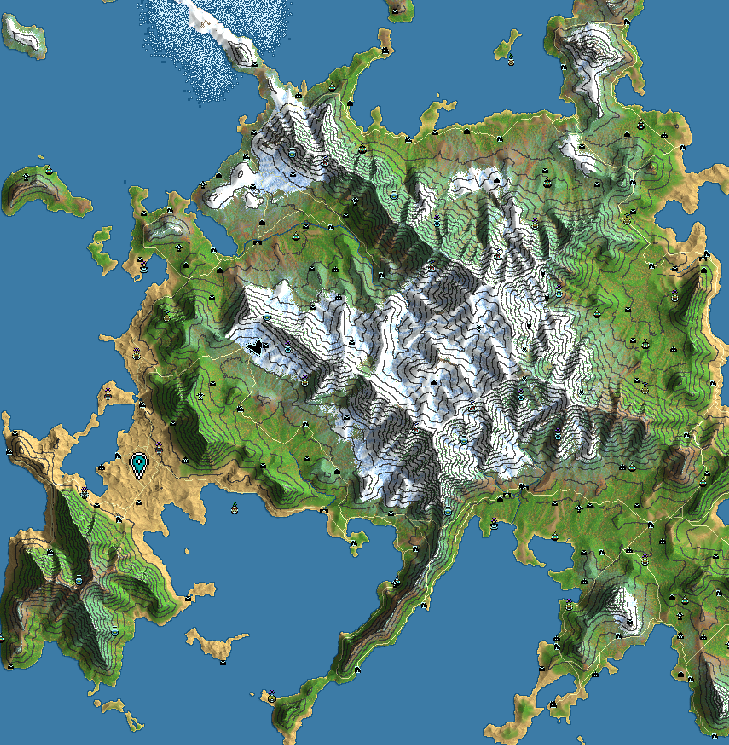
In addition, we get to spend time performing some simulation of the world before the game starts, resulting in more interesting features.
A short aside on what 'procedural generation' even is
If you ask most folk to describe procedural generation, they might say something like ‘random game content’. This is exactly backward: procedural generation is about defining constraints between elements of gameplay that tickle the habitual pattern-matching tendencies of the human brain.
The best procedural generation systems will weave complex narrative threads through a world not via some random walk through a combinatoral space, but instead by ensuring self-consistency. If you find a river, you should be able to walk to is source. If you come across a monster, you should be able to find its lair. If you slay the monster, the way characters in the nearby town talk about your character should change.
Good procedural generation systems need almost no randomness, because randomness is what players bring to the table: the purpose of a procedural generator is to push back against that randomness and coerce it into a self-consistent system with consequences.
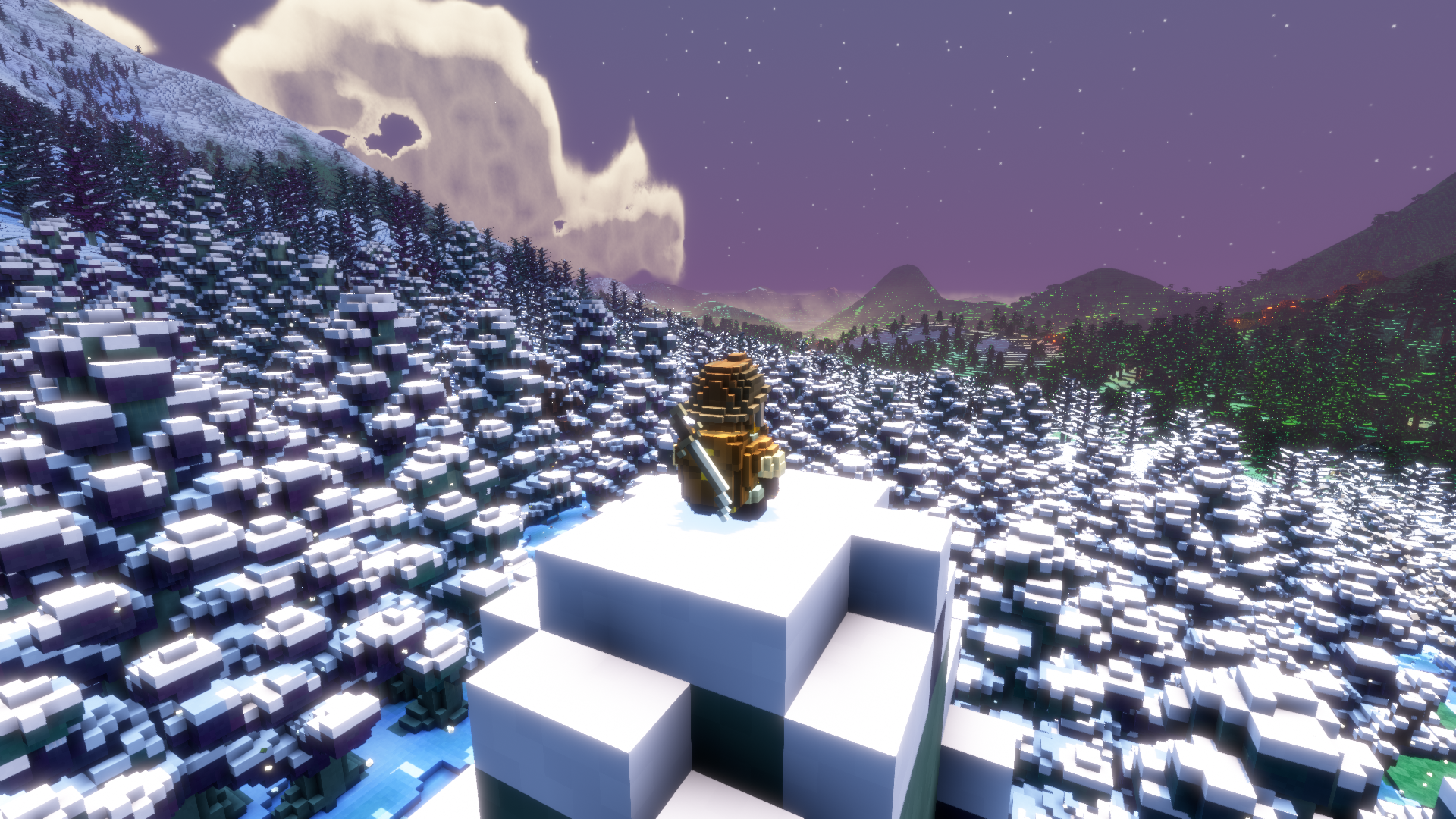
Another advantage of this low-resolution pre-generation step is that we can produce accurate LoD (Level of Detail) stand-ins for distant terrain, resulting in a virtually unlimited view distance even on low-power hardware.
Physically-based world generation
Most voxel games make heavy use of teleological procedural generation. This generation philosophy focusses on aesthetic outputs; are the colours artistically fitting? are the mountains interesting enough? does the world ‘look right’? Common to this philosophy are techniques like procedural noise or semi-stochastic algorithms like Wave Function Collapse.
Instead, Veloren leans much more heavily on top-level ontological procedural generation. Instead of focussing on outputs, the focus is instead on defining an interal model of the world that recreates the physical inputs to processes and then simulates their effect on the world.
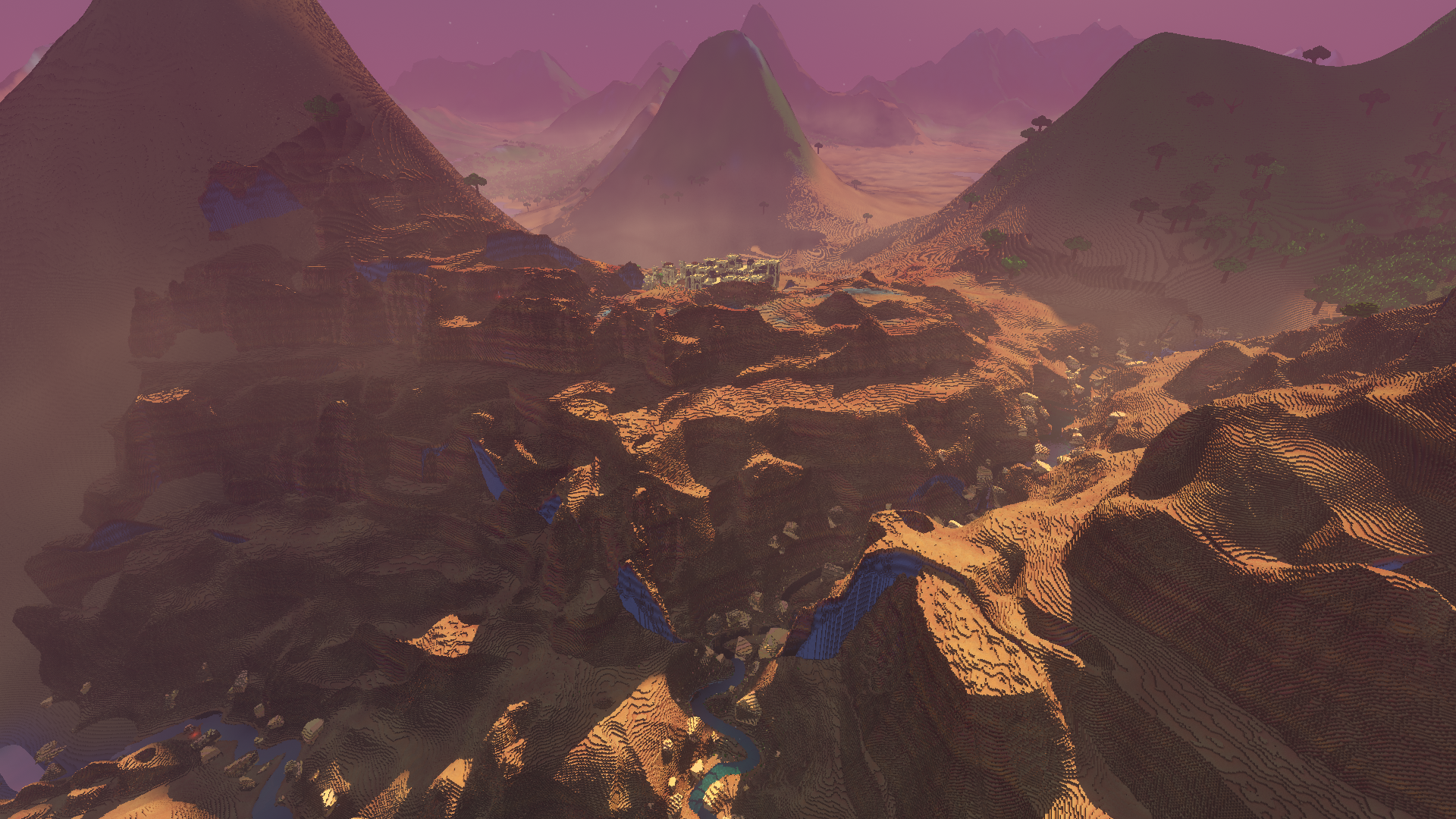
The most obvious example of this is our physically-based hydraulic erosion model that produces the mountainous terrain and complex river systems the game is so well known for.
Another example is our procedural path generator, which uses a simplified model traversal cost model to find energy-efficient routes between sites.
I believe that the physically-based nature of many of Veloren’s procedural elements are key to the coherent and ‘bigger-than-you’ feeling that Veloren produces.
RTSim
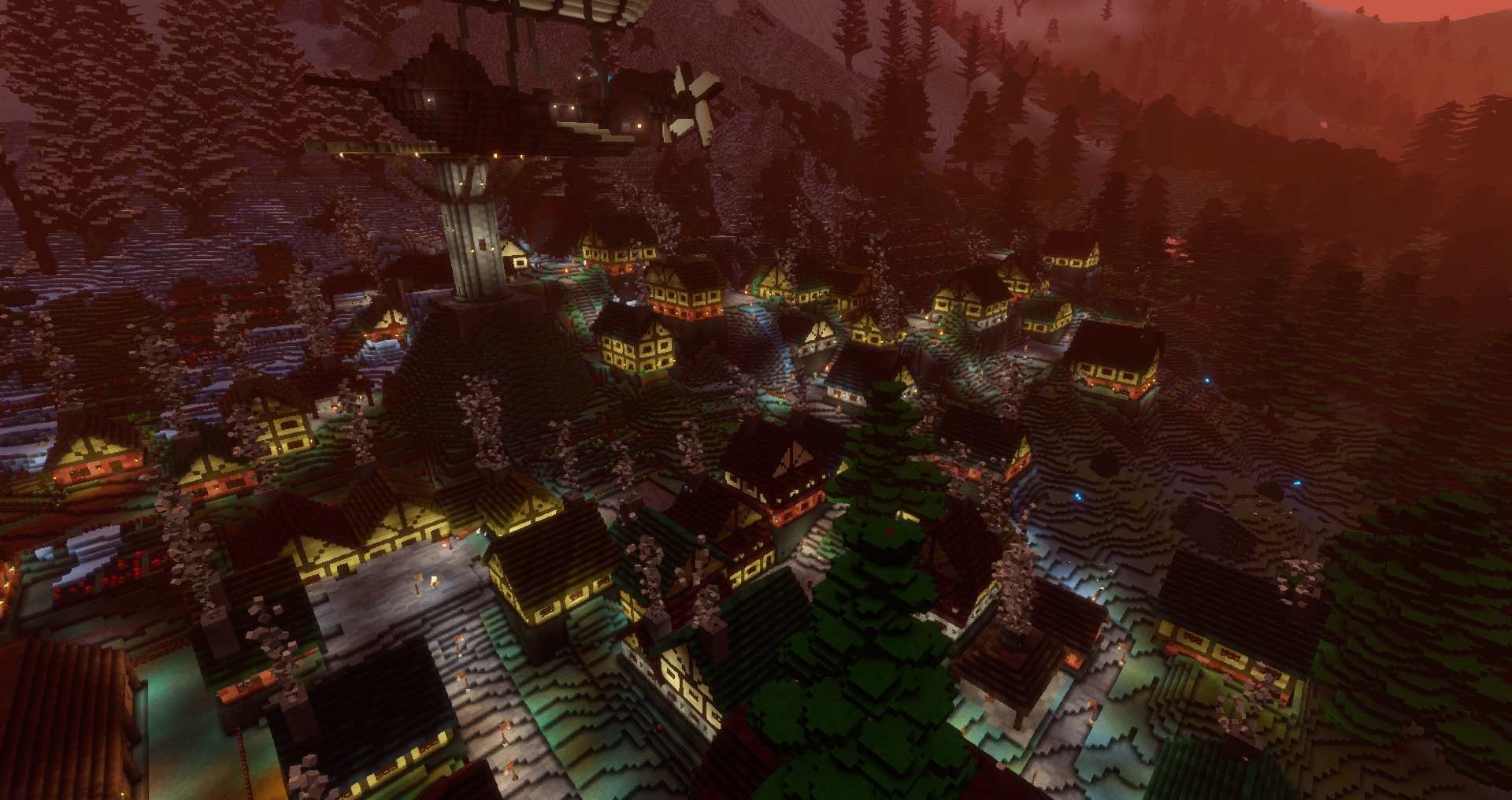
Veloren doesn’t stop doing physically-based simulation after initial world generation. The game has an internal world simulation system known as ‘rtsim’ (Real Time SIMulation) which uses the aforementioned low-resolution world data to continue simulating the whole world, even when no players are nearby.
Every NPC in the world has a dual residing within rtsim. When an NPC leaves the active view distance of a player, they don’t get despawned: instead, they’re subsumed into rtsim where the game continues to track their movements and simulate the effect of their high-level decision tree logic.
Rtsim is becoming an increasingly complicated part of Veloren and many of the more interesting dynamic aspects of the game now reside in it: quest simulation, faction dynamics, and even elements of the game economy are now tracked by it as the game runs. It’s possible to observe raids on sites by pirates and travelling bandits as they move across the world, for example. NPCs and in particular merchants will also migrate across the world.
Rtsim is designed to scale: most Veloren worlds contain upward of 10s of thousands of NPCs, and rtsim is capable of tracking them all simultaneously.
No invisible walls
A game design constraint that we set ourselves quite early on was that of avoiding ‘invisible walls’: these might be physical, like the boundaries on the edge of a game’s world map, or they might be conceptual, like a game refusing to permit interaction between two elements in the world for arbitrary reasons.
Imposing this constraint has created significant problems for game balance, as well as designing proper interaction between gameplay elements. It is not clear, for example, how the game even should react when a mischievous player decides to pull a mighty boss out of their dungeon and into a nearby town. But, Veloren permits you to do this, and that constraint has encourages us to design game systems defensively with the expectation that they may have to continue functioning in extremely unusual circumstances.
One world space
Many game decide to split their world into distinct areas for the purpose of performance or artistic decisions, with loading screens separating them. Veloren chooses to avoid this entirely and places all gameplay elements into the same physical world space.
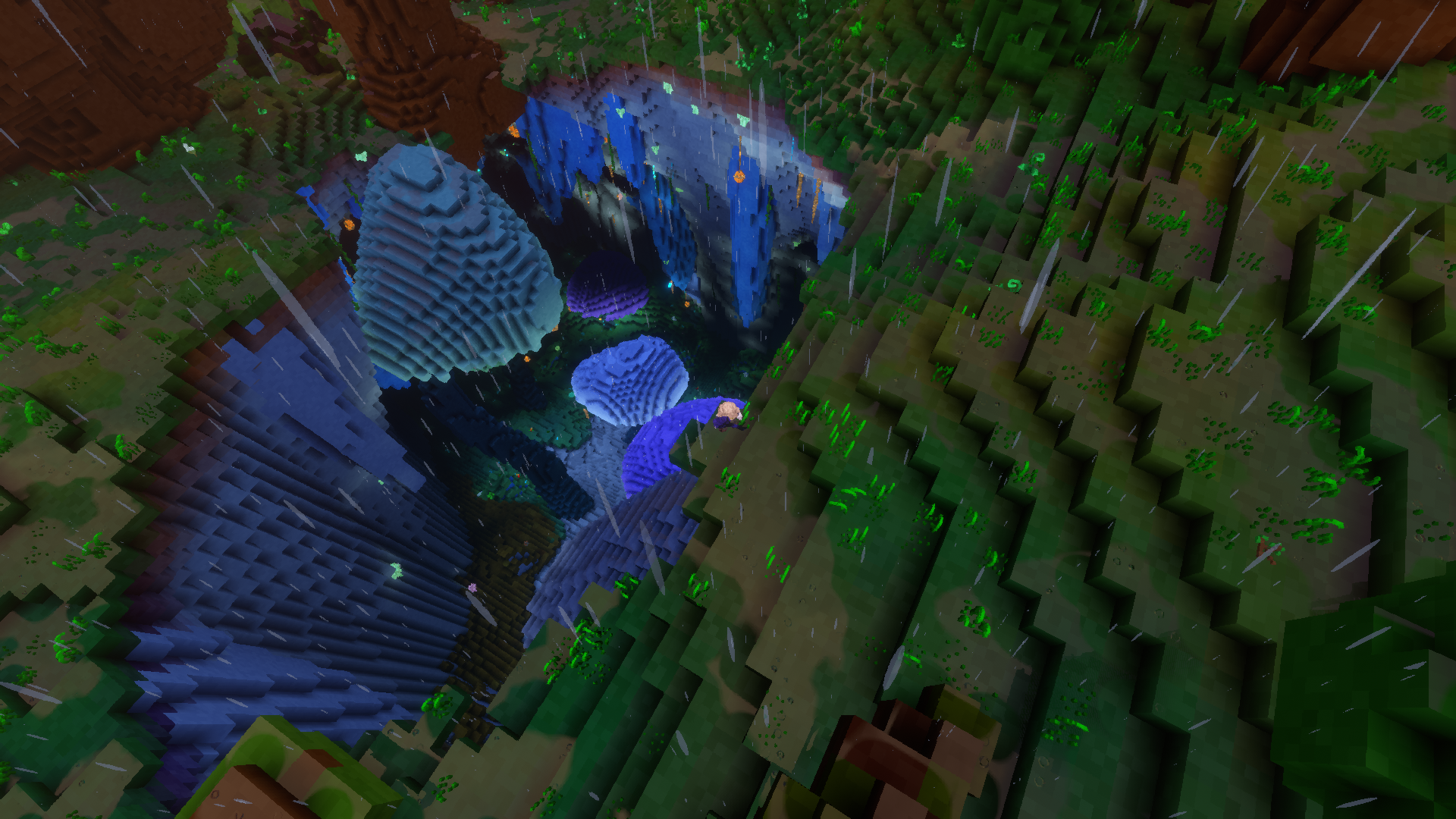
One feature of the game where this results in complexity is the elaborate cave system that weaves underneath the world. This cave system can sometimes be up to a kilometre under the surface of the world, and often is many levels deep, so keeping the game performant when there’s a cave network under the player’s feet has been a challenge.
A surprising problem to solve here is lighting. Veloren has a much more diverse lighting model than most voxel games and supports baked voxel lighting, point lights, directed shadow mapping, reflections, an ambient light model, volumetric fog and clouds (which both result in light scattering), etc. Ensuring that no lighting information from the surface makes its way down into the deepest cave, even in the middle of the day, was surprisingly complicated: global effects like lightning strikes have a tendency to leak ambient lighting data through shadow maps and appear in screen-space reflections even when care is taken to isolate them, and a lot of time has been spent ensuring that the visibility of these effects from the player’s perspective is properly accounted for.